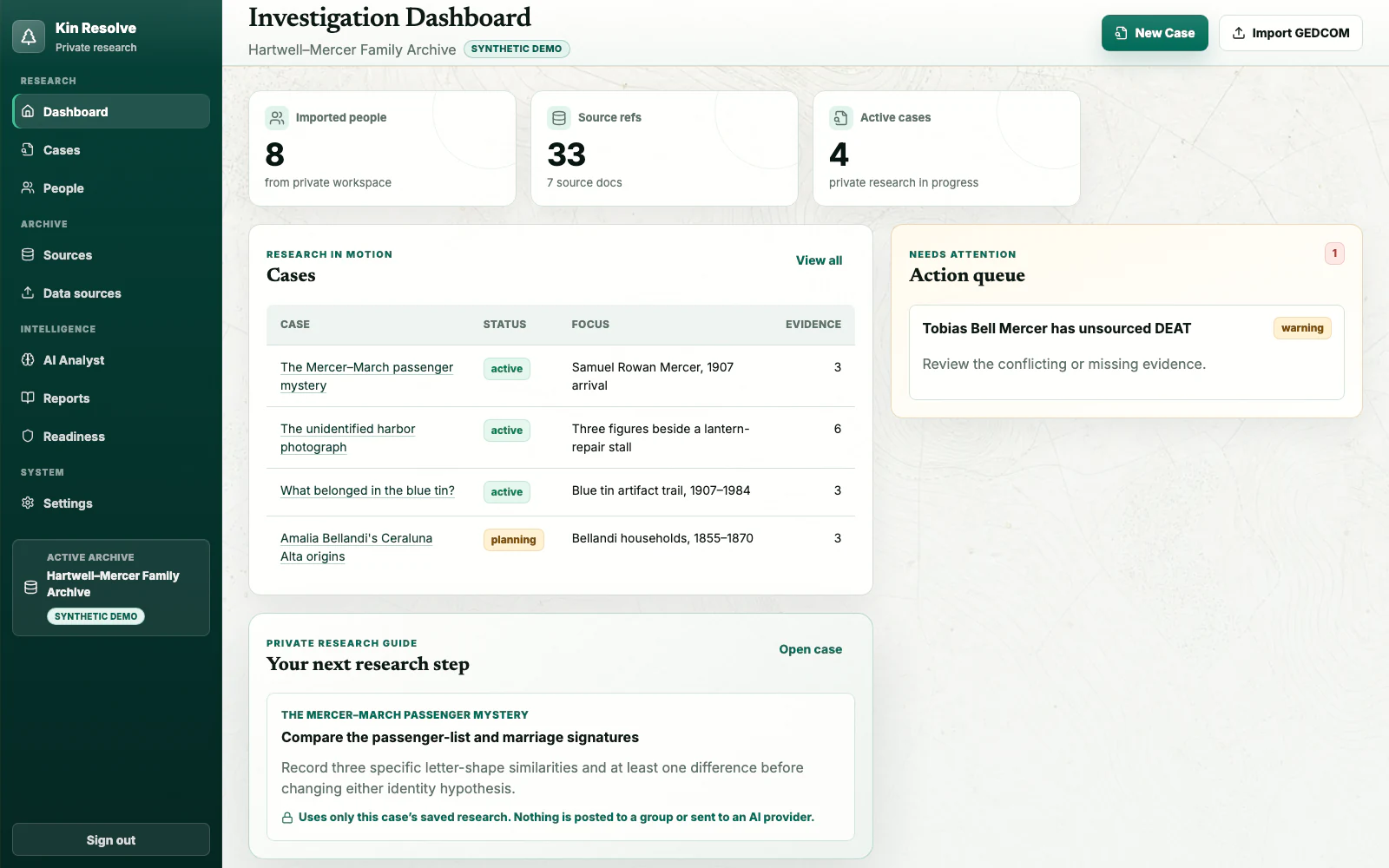
The productOne workspace for the work behind the tree.
Connect imported records to questions, sources, DNA clues, analysis, and publishing decisions—without turning a working hypothesis into a fact.
A connected workspace
The research trail stays attached.
People, sources, cases, matches, and analysis are useful on their own. They become far more useful when you can see which question each item informs—and what remains uncertain.
Every example below is fictional. All Hartwell–Mercer names, dates, places, records, photographs, file names, and DNA values were invented for the demo and do not describe real people.
01 / Archive integrityImport without flattening the record.
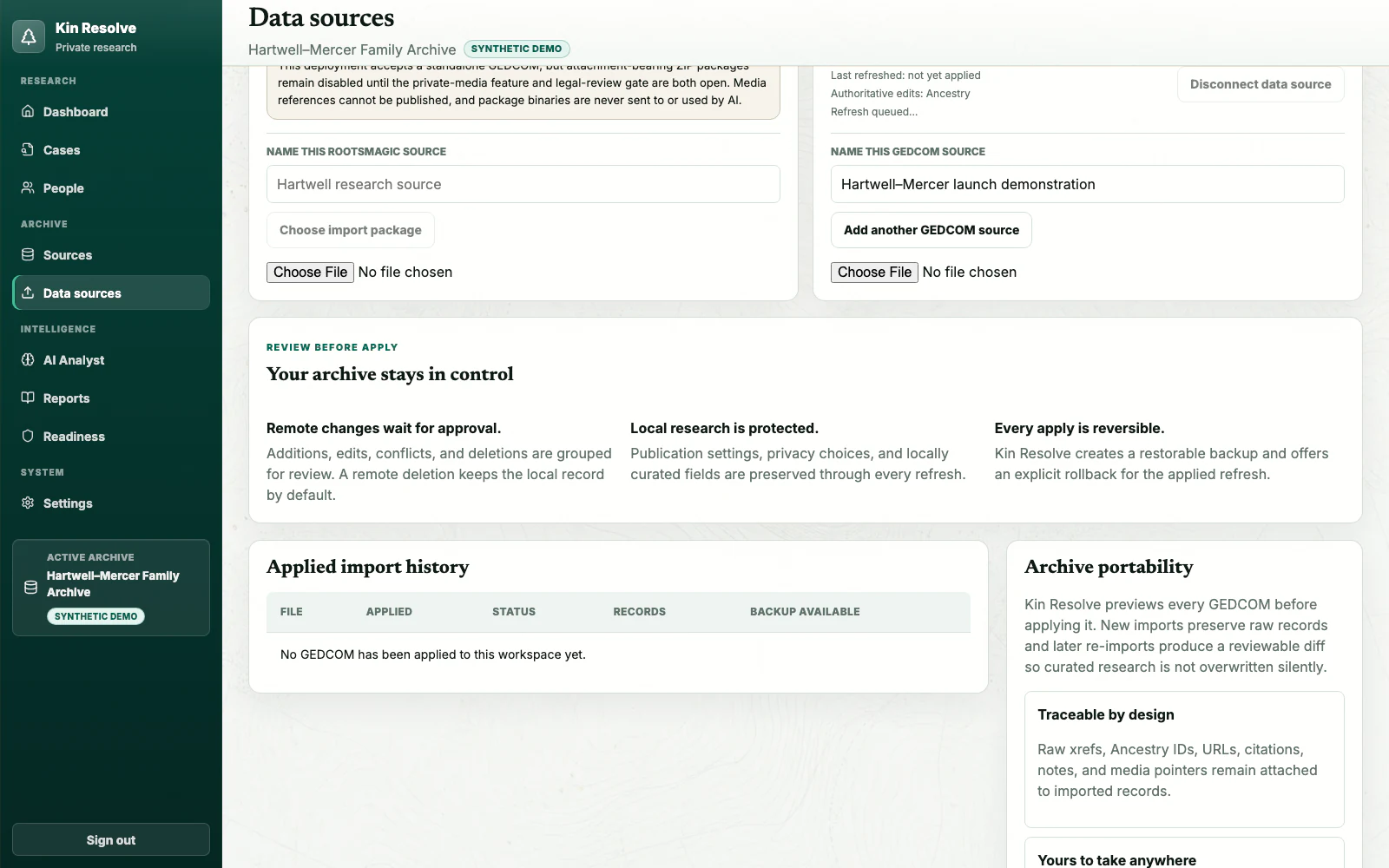
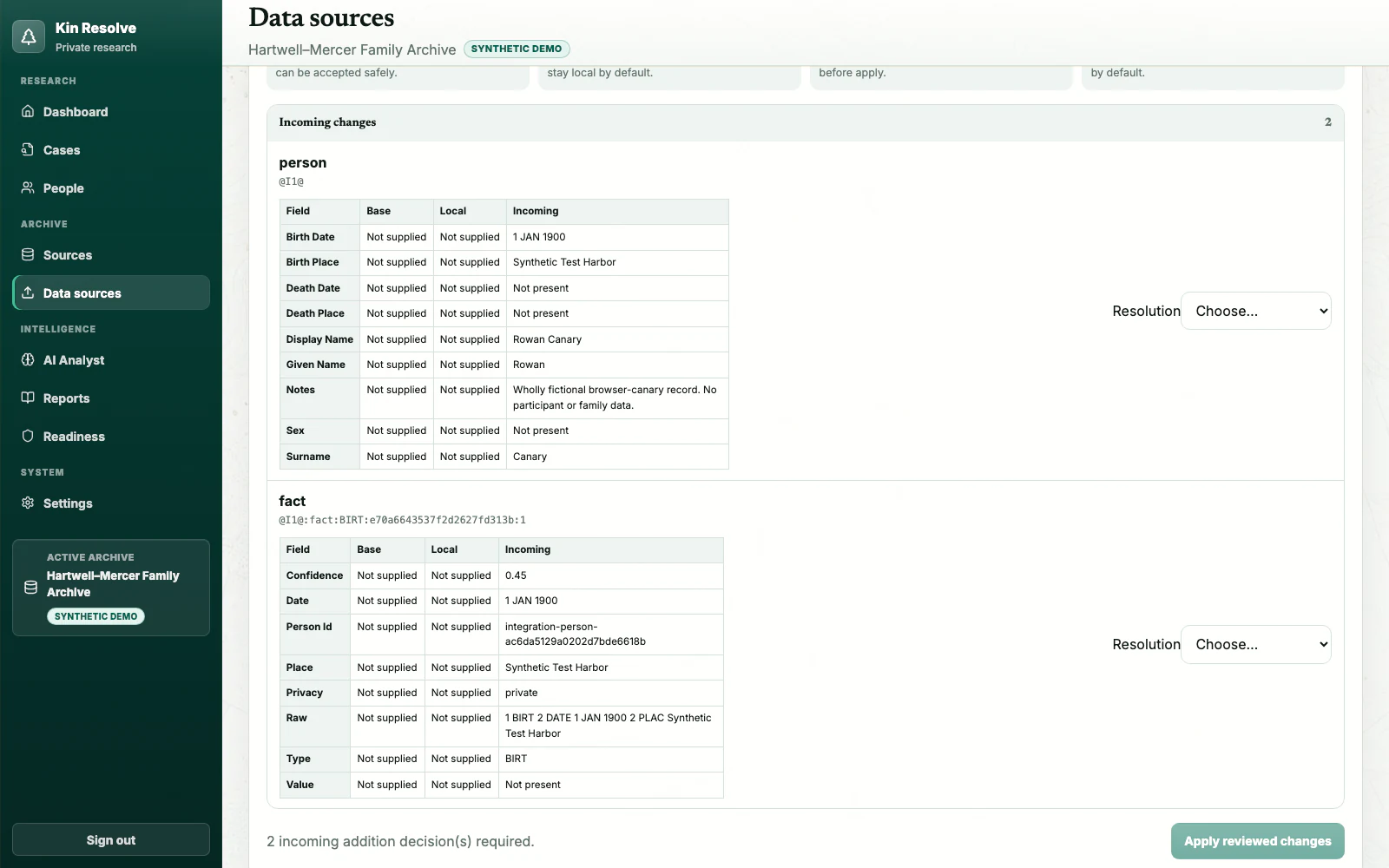
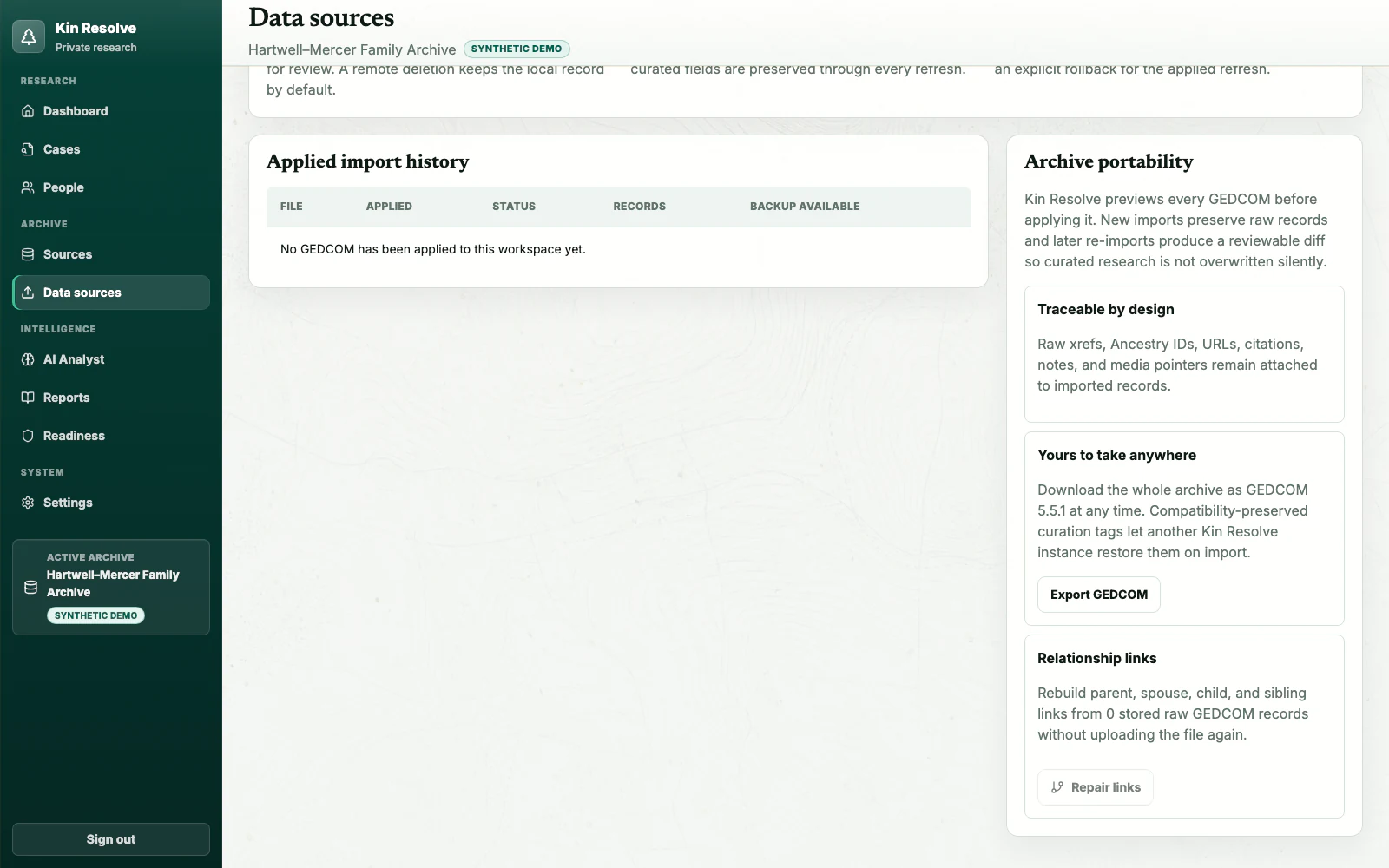
Preview a GEDCOM before it changes the archive. Kin Resolve preserves raw records, xrefs, custom tags, notes, source references, and checksums, then shows reviewable changes on re-import.
- Preview before apply
- Reviewable re-import differences
- Pre-import recovery snapshot
- Full GEDCOM 5.5.1 export
Import review
hartwell-mercer-fictional-demo.ged
New people16
New families7
New sources4
02 / Focused researchWork a question, not just a person.
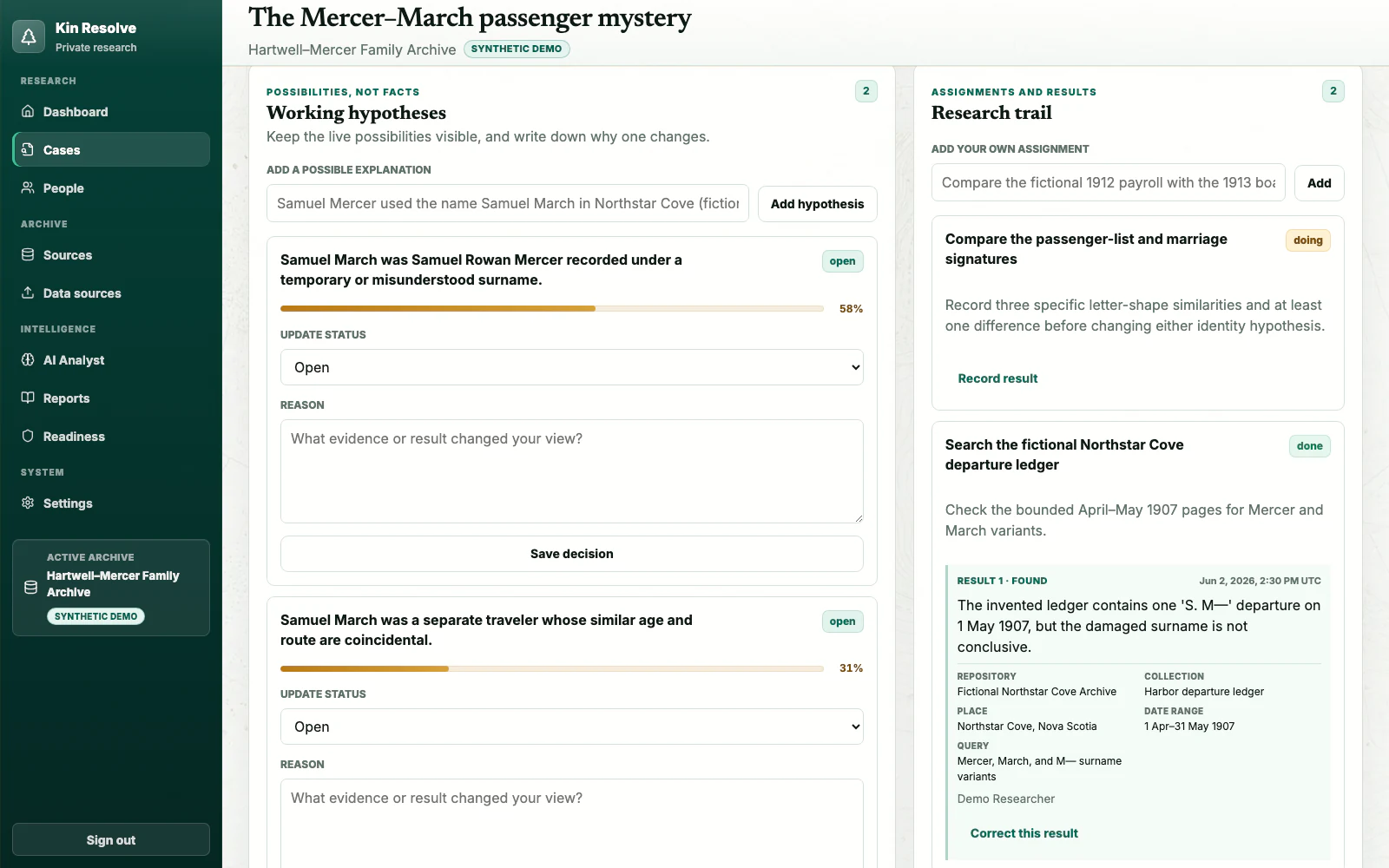
Cases hold the question, evidence, hypotheses, confidence, and next actions together. The tree remains a record of conclusions; the case preserves how you got there.
- Evidence linked to people and sources
- Competing hypotheses
- Confidence and rationale
- Reviewable next-step queue
Active case
Mercer–March passenger mystery
Evidence items3
Hypotheses2
Open tasks1
03 / Sources in contextKeep citations close to the work they support.
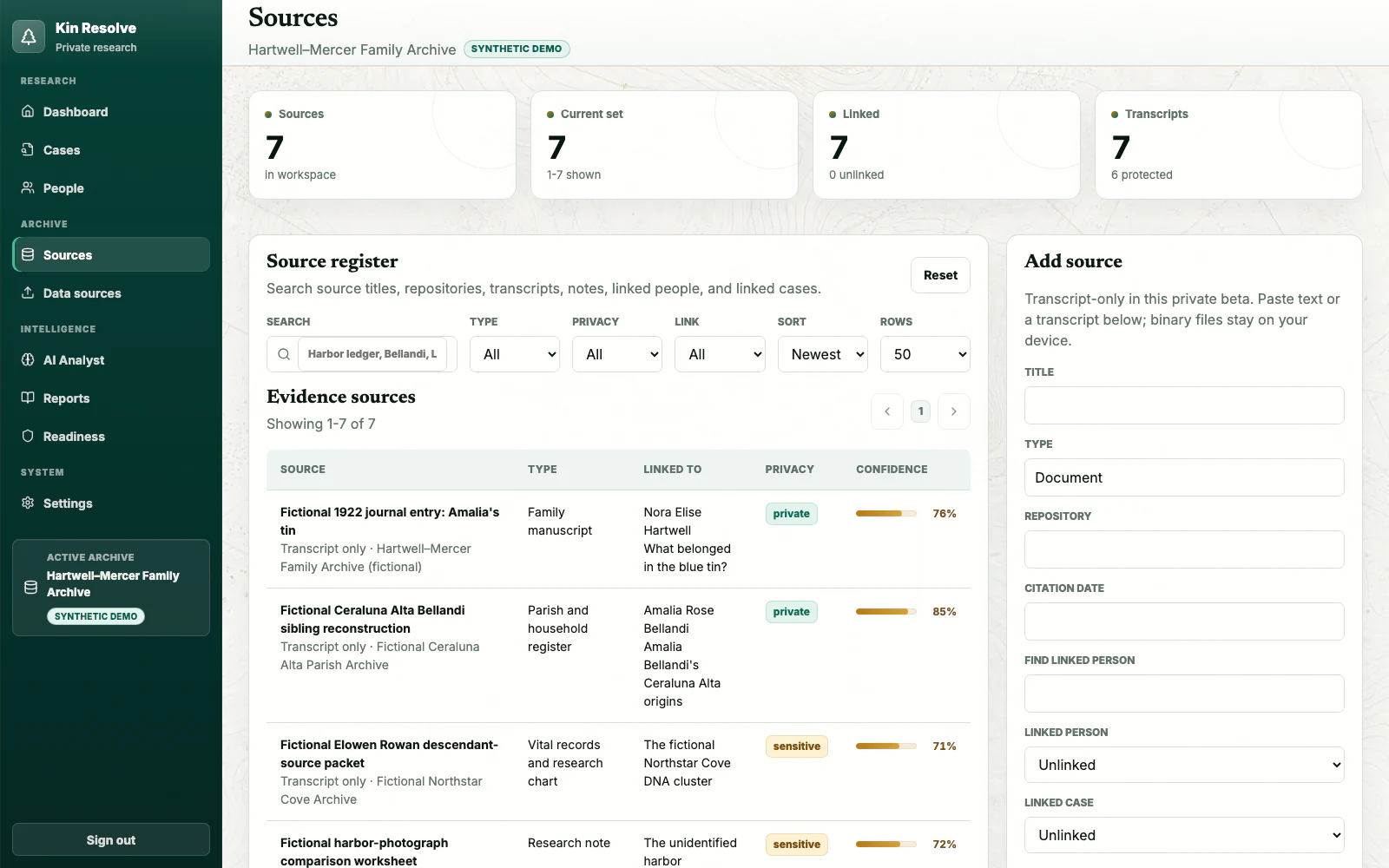
Search source records and transcripts, connect them to people and cases, and make gaps visible before a conclusion or public profile is treated as finished.
- Source register and search
- Transcripts and archive details
- Person and case links
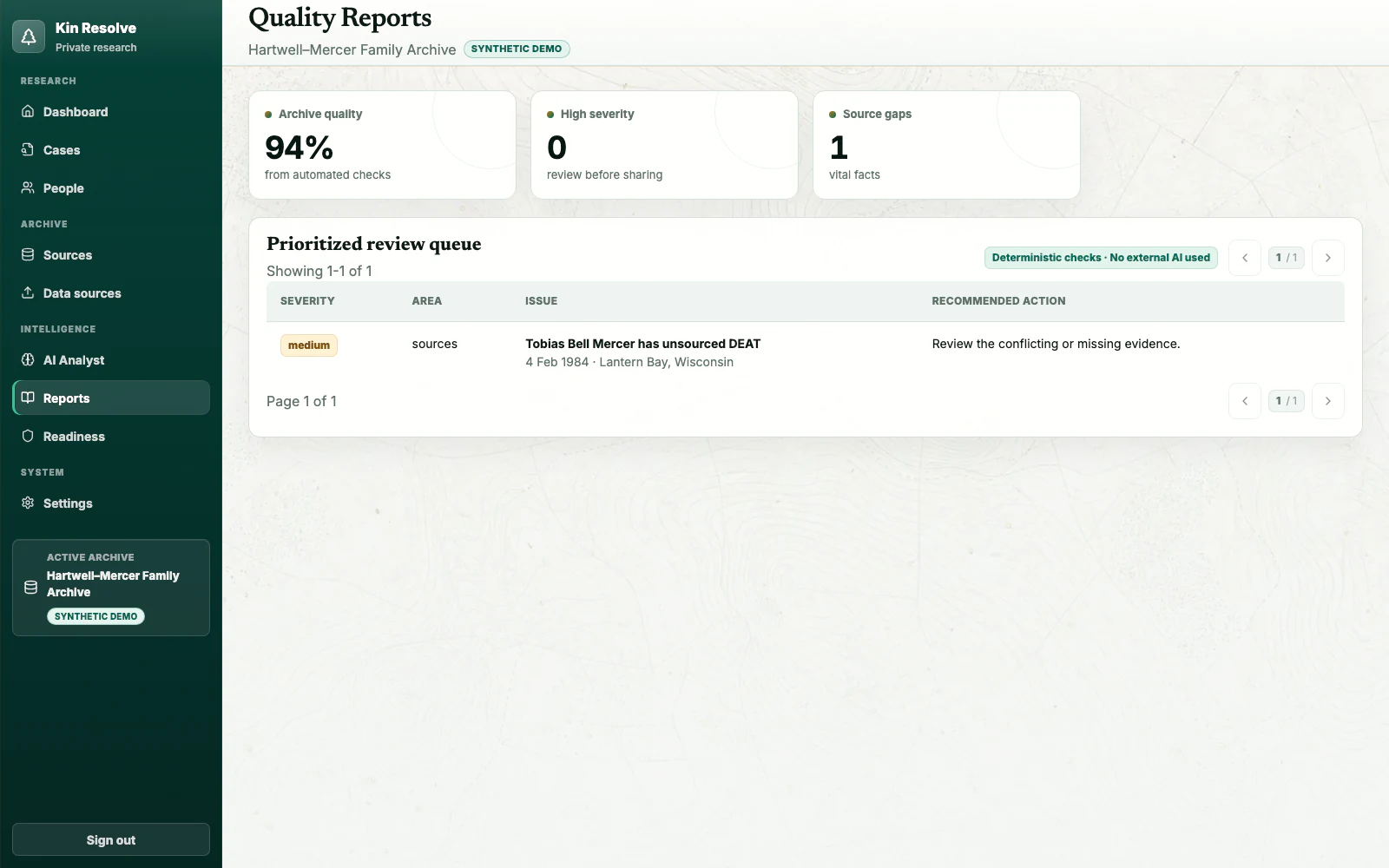
- Coverage-gap reporting
Source review
Fictional Lantern Bay civil register: Nora Hartwell
Linked people1
Linked cases0
TranscriptReviewed
04 / DNA as a clueTriage matches without turning a score into a fact.
The source product can import match CSVs, rank useful leads, record shared-match context, and connect promising matches to a research case. Hosted DNA is excluded from the proposed first cohort.
- CSV import and match scoring
- Surname and place clues
- Shared-match context
- Case evidence links
DNA lead
M. Alder (fictional)
Shared DNA86 cM
TreePartial
Estimate3C or 3C1R
05 / Optional analysisUse AI as an analyst, not an authority.
Deterministic structural checks work without an AI key and are proposed for cohort one. The source product can connect an OpenAI-compatible provider, but external AI is excluded from the proposed hosted cohort.
- No-key structural checks
- Operator-selected provider
- Referenced workspace context
- Saved runs and staged suggestions
Analysis run
Mercer–March identity check
Context records3
Identifiers2 independent
ConfidenceModerate
06 / Deliberate publishingReview before sharing.
The source product combines manual person publication with living-person and privacy gates. Publication-readiness checks are proposed for cohort one, while real-data public publishing remains disabled.
- Manual person publication
- Living and privacy gates
- Readiness blockers
- Anonymous public profiles
Publishing review
Nora Elise Hartwell
PrivacyPublic
Living statusDeceased
Public facts4
Private beta applications openPrivate beta applications are open.
Invitations have not started; hosted access begins only after the launch gates pass.
Implemented in source- Single-archive private research workspace
- GEDCOM import preview, review, apply, rollback, and export
- People, source, case, evidence, hypothesis, and task workflows
- Deterministic quality and privacy checks
- Private object storage and durable background jobs
This is a code-state claim, not a hosted-availability claim.
Proposed after launch gates- A synthetic demo before any private family data
- One isolated plain-GEDCOM pilot after every real-data gate
- Founder-operated onboarding, export, deletion, and support
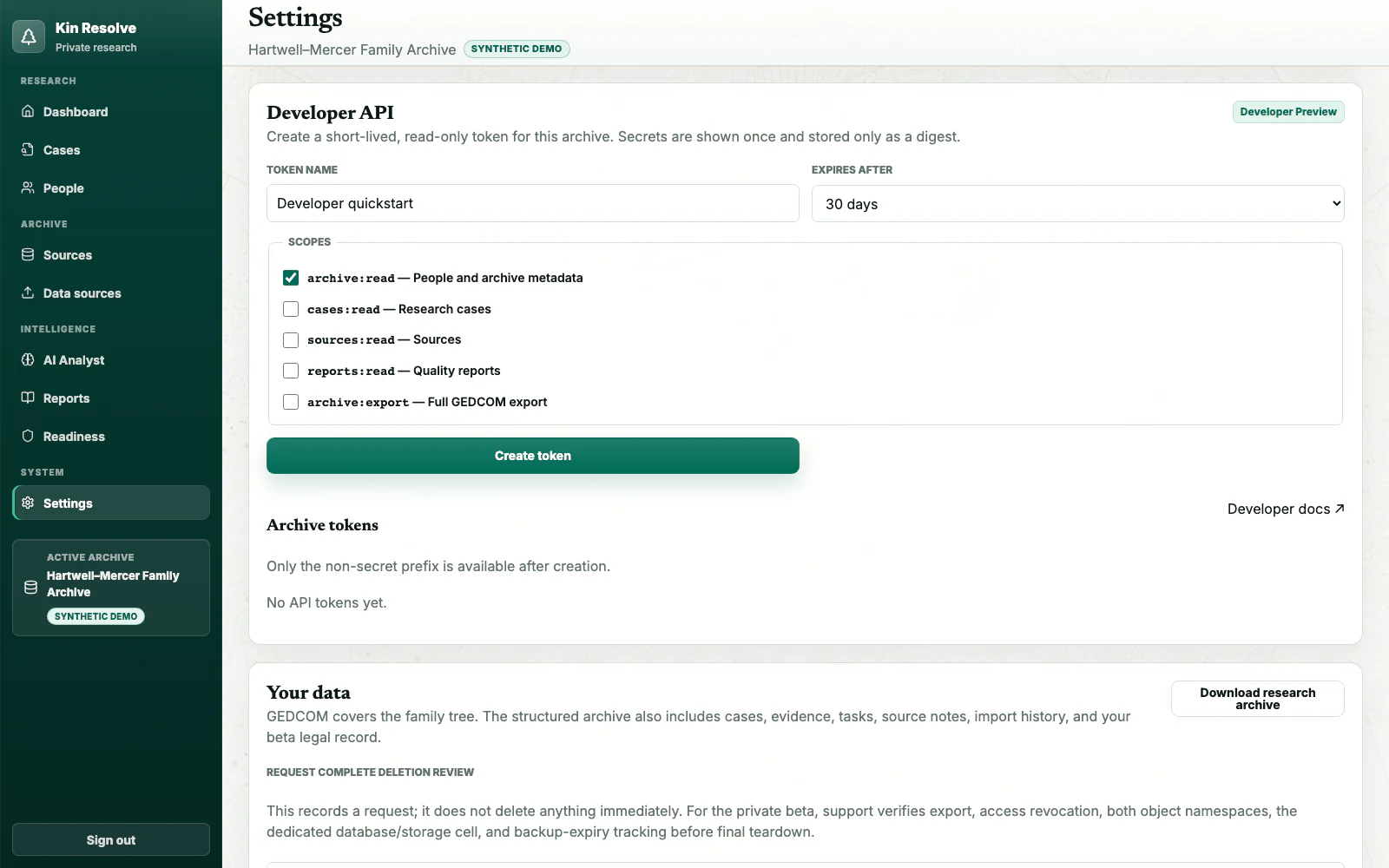
- A scoped, read-only API preview after its separate launch gate
Each item still depends on its applicable approval and production evidence.
Disabled or excluded- DNA uploads or triage
- External-provider AI
- Media packages or binary source attachments
- Real-data public publishing
- Open signup, billing, or shared multi-family hosting
These are server-enforced cohort boundaries, not omissions hidden only in the interface.
Try the working productWork the fictional Hartwell–Mercer mystery in Kin Resolve.
Start in a temporary fictional workspace, then investigate thirty synthetic record images and transcripts across five immersive cases.