Evidence-led genealogy research
Resolve the questions your family tree can’t answer.
A family tree captures conclusions. Kin Resolve keeps the evidence trail—records, sources, research cases, DNA clues, and careful analysis—in one private workspace.
Invitations have not started; hosted access begins only after the launch gates pass. Source available under AGPL-3.0-only.
Focused questionWere Samuel Mercer and Samuel March the same person?
Compare the signatures, then test them against an independent source. Matching age and route alone are not enough.
Independent identifierMaeve’s 1906 letter mentions both surnames without explaining why.
LetterQuestion still openOne person, or two? Weigh the identifiers before deciding.
Needs reviewFictional demo: every name, date, place, record, photo, and DNA value here is invented.
Fictional demo universe. Every Hartwell–Mercer name, date, place, record, photograph, story, and DNA match shown on this site is invented. No real family data is used.
An archive mystery
Test your research instinctsThink like a researcher.
Examine thirty synthetic records across five immersive Hartwell–Mercer cases, build a cited clue notebook, and test conclusions against conflicting evidence.
Private research workspacePortable GEDCOM exportOpen AGPL sourceCautious AI assistance
The work behind the treeA family tree shows who.
A family tree shows who.
Research explains why.
The difficult work lives between the records: conflicting dates, missing sources, uncertain relationships, DNA clues, and questions that remain unresolved.
Kin Resolve keeps that work connected to the people and evidence it concerns—without smoothing uncertainty into a neat but unsupported answer.
A reviewable workflow
Explore the research method From imported records to reviewed conclusions.
Bring in the record
Preview a GEDCOM before applying it, preserve raw references, and keep an export path open.
Work the question
Organize evidence, hypotheses, and next steps inside a focused research case.
Compare the clues
Review documentary gaps and DNA matches without treating a suggested relationship as fact.
Publish deliberately
Check privacy, living status, and publication readiness before a profile becomes public.
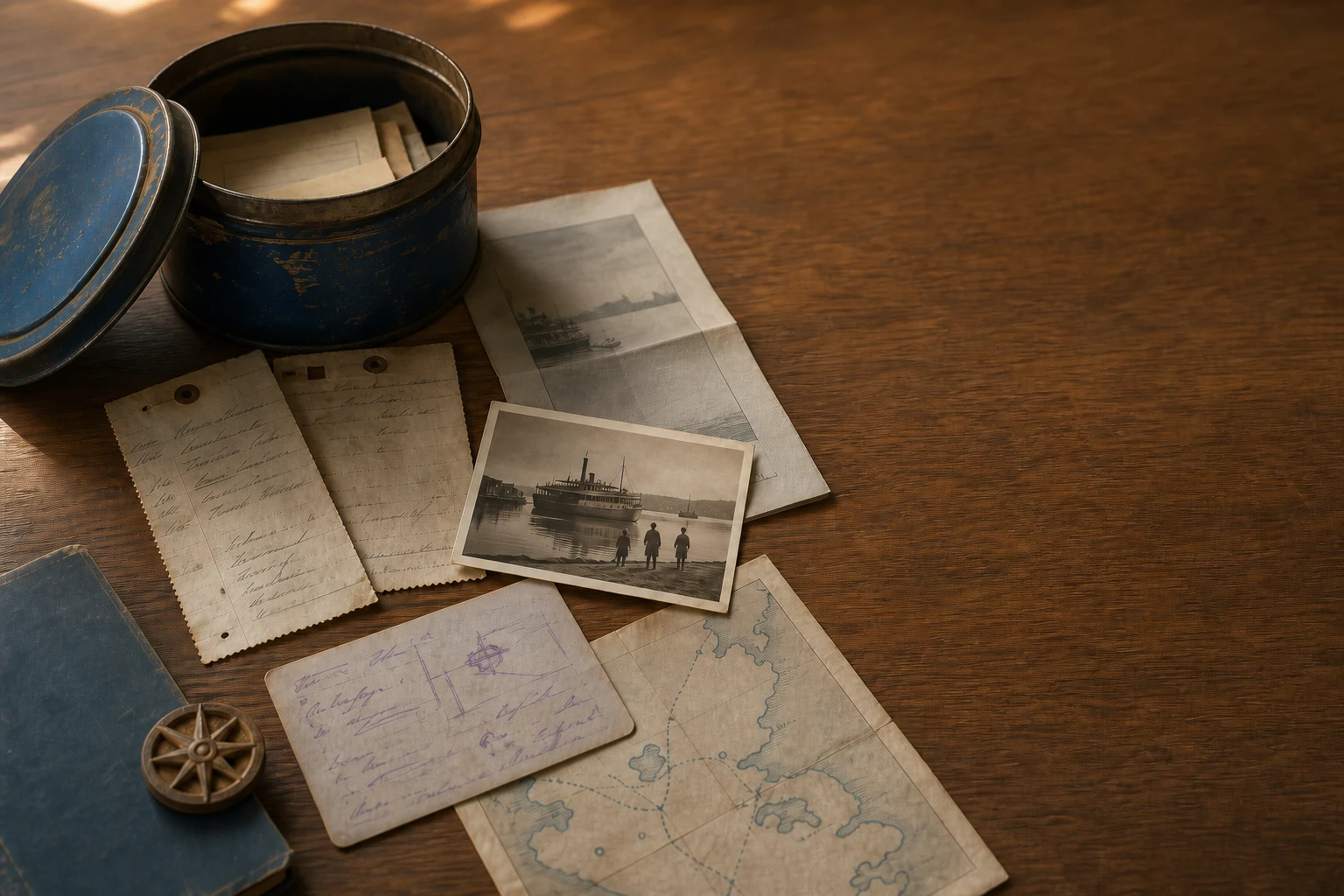 Fictional Hartwell–Mercer archive · no real family data
Follow the trail
Keep the question, the clue, and the conclusion together.
Nora Hartwell’s 1922 journal calls the box “Amalia’s tin,” while an older family story credits Samuel. Inside are the passenger notice and harbor photograph he brought from Northstar Cove in 1907. Elsewhere in the archive, the 1907 passenger-declaration and 1909 marriage-ledger signatures can be tested against Maeve Mercer’s independent 1906 letter. Which claim survives the evidence?
- Separate what a source says from what you infer.
- Record the conflict instead of quietly choosing a favorite.
- Show confidence without presenting a hypothesis as proof.
Private beta applications open
Built for the work behind the tree.
Private beta applications are open. Invitations have not started; hosted access begins only after the launch gates pass. The source product already contains the research tools below; the hosted cohort will start with a narrower, explicit boundary.
GEDCOM integrity
Preview imports, review re-import changes, preserve raw records, and export the archive again.
Research cases
Keep evidence, hypotheses, confidence, and next actions attached to the question they support.
Source workspace
Search source records and transcripts alongside the people and cases that depend on them.
DNA match triage in source
The source product can score and review CSV-imported matches as research leads. Hosted DNA is excluded from the proposed first cohort.
Quality checks
Surface date conflicts, privacy risks, source gaps, and profiles that are not ready to share.
Optional analysis in source
Use deterministic checks alone in the proposed hosted cohort. Operator-configured external AI exists in source but is excluded from cohort one.
Research aid, not authority
AI that supports the researcher—not replaces one.
Kin Resolve can run structural checks without an AI provider. When an owner connects an OpenAI-compatible provider, the analyst can answer from workspace context, show the references it used, record uncertainty, and stage suggestions for review.
Provider-backed analysis may send private workspace context to the operator’s configured provider.
Read the data practicesAnalysis / Fictional Case 07Fictional demo
“Were Samuel Mercer and Samuel March the same person?”
The sources narrow the question, but do not decide it for you.
The fictional 1907 passenger-declaration and 1909 marriage-ledger signatures share an unusual final stroke. Maeve’s independent 1906 letter mentions both surnames without explaining why. Matching age and route alone would not be enough.
[R4] Passenger declaration[R6] Marriage ledger[R2] Maeve’s letter
! Working analysis. Review source images before changing the tree.
Two deliberate surfaces
Private research. Carefully shared family history.
Keep the unfinished work private.
The source product keeps imported people, sources, DNA matches, cases, notes, and analysis runs behind authenticated workspace access. The proposed hosted cohort excludes DNA and external AI.
- Research cases and hypotheses
- DNA match triage
- Source transcripts and notes
Share only after review.
Person-level publication and living-person gates protect the current public archive while more granular controls remain in development.
- Selected ancestor profiles
- Living-person privacy gates
- Publication-readiness review
Build in public
Follow the roadmap Private beta applications are open.
Invitations have not started; hosted access begins only after the launch gates pass.
- Single-archive private research workspace
- GEDCOM import preview, review, apply, rollback, and export
- People, source, case, evidence, hypothesis, and task workflows
- Deterministic quality and privacy checks
- A synthetic demo before any private family data
- One isolated plain-GEDCOM pilot after every real-data gate
- Founder-operated onboarding, export, deletion, and support
- A scoped, read-only API preview after its separate launch gate
Private beta
Bring a real research question to Kin Resolve.
We’re looking for family historians willing to test GEDCOM review, source, research-case, deterministic-check, and export workflows. Apply with the workflow—not private records.